Saturday, December 22, 2007

Gas Prices: These High School kids and their crusin' today!


In 1981, I used to get $5 bucks a week to "fill" my car up and go High School cruisin'. But would that be like getting $10 bucks a week now. Clearly, kids today have a much better economic situation to go cruisin' on the weekends than did I. In fact, they have it about twice as much better:
To be as expensive as gas in 1981, measured as the cost per 1,000 gallons as a share of per-capita net worth, gasoline today would have to sell for about $6.50 per gallon. Bottom Line: Gas today, even at $3, is relatively affordable and is actually cheaper than the decades of the 1940s, 1950s, 1960, 1970s and 1980s, when the price of gas is measured relative to our increasing household wealth. Goldilocks can handle $3 gas.[1]
Furthermore, the average car gets better gas mileage than those of 1981. So, quit all your complaining you slack-jawed whipper-snappers!! These are the good-ol'-days! (Although, about ten years ago, it was even "gooder" days for cruisin'.)

REFERENCES

[1] Mark J. Perry "Why The Goldilocks Economy Can Handle $3 Gas II" CARPE DIEM: Blog for Economics and Finance December 7, 2007 (Accessed 12/16/07)


O.

Labels: , , ,

Monday, January 01, 2007

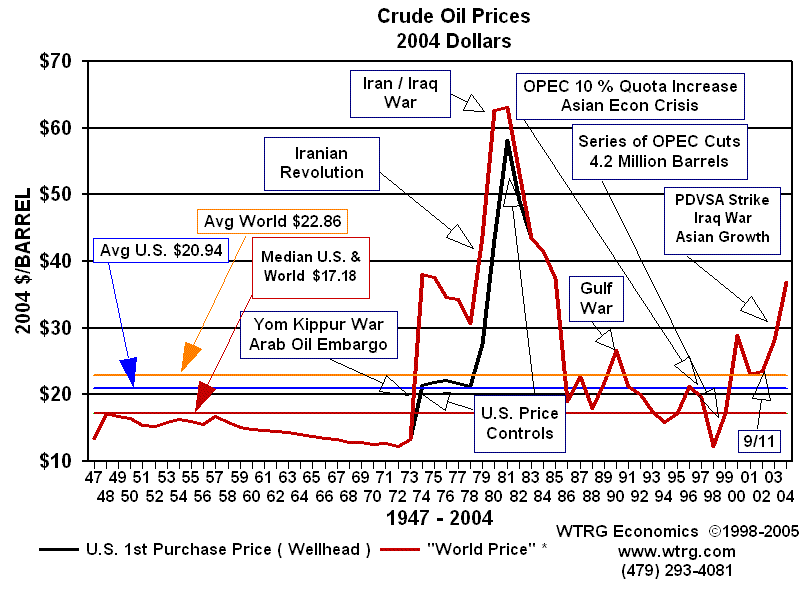
Today's Oil Price vs. 1979


Back in 1979 when I was driving around in High School, gas was considered shockingly expensive, yet in absolute dollars, we pay more for gas today than back then. While gas is not considered cheap, it is still a far better situation for US buyers than was the case in '79. Tim McMahon explains why the money situation is indeed more comfortable today:


Oil would have to average $100.52 for the entire month to be as high as the price we saw in December of 1979. But we are "only" paying about one half that amount. Another factor that makes the Oil price worse in 1979 is the fact that back in '79 interest rates were two to three times higher than they are now, peaking in the high teens. Combine lower mortgage rates with lower taxes and the modern household actually has $500 extra cash available each month... which will buy a lot of gasoline.[1]


Apparently, we are approaching a similar bying-power cost point in oil prices, but we have a far better economy to absorb that pain, so even equivalent spending value will keep us in a slightly better position (unless the economy tanks).


However, I note there is also the new technology curve that is working in our favor. Right at $100 a barrel, other alternative energy sources become economically viable. On my view, if these remain economicially viable for any length of time, then there will be R&R on those alternative fuel technologies, and then they will become even more viable, thus weaning us off oil bit by bit. I heared on a news show a year back or so that if oil hits $100 a barrel on average for a year, the next year it will go down to $30 dollars a barrel, since too many other energy technologies would come on line to compete with oil. I believe that's true.

I've always regretted that the US governement didn't have the political courage to invest in better energy technlogy back in the 1970's, but paying high retail prices for a couple of years might be the equivalent of a grass-roots tax that opens up motivations for markets on an issue where the US government failed.
Hey, I'm willing to pay that pump cost for a while if new energy tech is the end result. The question is, "How long is 'a while'?"


REFERENCES

[image] "Oil Price History and Analysis" WTRG Economics (Accessed 1/1/2007)

[1]"Why Oil Prices haven't Crippled the US Economy Yet" Financial Trend Forcaster (Accessed 1/1/2007)

.O.

Labels: , , ,