Thursday, April 05, 2012

On the baby without a brain turning two years of age


What can one assess about responsibility toward such a child?

Big-shot Enlightenment era philosopher, Immanuel Kant's ethical position holds that not only actual people, but even potential people have moral worth, thus why some opponents of abortion say that such an act is morally wrong:  a fetus in utero, otherwise not interfered with, will become a person.  But in this case, taking Kant's position, the baby, lacking a brain, is not even a potential person.

Now there is a counter-argument here.  One issue in all this is whether "person" is a concept defined (i) by the ability (or potential ability) to be come actual, as Kant's position holds; or (ii) by the the imputation of personhood by those in a social circle.  Regarding this second point, the family plainly imputes personhood to this child, as did one of the TV anchors, at least weakly, when he claimed that the child seemed to recognize its parents.  But such "seeming" recognition is often at issue in medical cases -- such as where someone has been in an otherwise unrecoverable coma, but the family claims to see responses of the person "in there".

Given only the brevity of this video, and the claims about the baby's medical condition, I would assert with full confidence the "seemings" position, but I know good-and-well that with time and constant exposure, I too would be psychologically unable to maintain that position, which for the same reason people so easily impart mindedness to a "Kismet" machine.[1]

O.

REFERENCES

[image] "Baby born without brain turns 2" YouTube, Dec 8, 2010 (Accessed April 5, 2012)

[1] "Kismet (MIT A.I. Lab)" YouTube, Sept 7, 2011 (Accessed April 5, 2012)

Labels: , , , , ,

Saturday, March 20, 2010

Mirror Neurons/Systems Present Method Problems for Science


Giving empirical explanations for what mirror neurons are supposed to be doing in the brain ain't as easy as one might wish.

Mirror neurons are "a particular class of neurons, originally discovered in the ventral premotor cortex, that code goal-related motor acts such as grasping. Specifically, mirror neurons require action observation for their activation; they become active both when the subject makes a particular action and when it observes another subject making a similar action."[1] For example, implant wires in the appropriate region of a monkey's brain, and you can detect when these kinds of neurons fire. So when a monkey watches a researcher bring an object to his mouth (e.g. an ice cream cone), the same neurons will fire as if the monkey were bringing food to its own mouth.

Mirror neurons fire both when an animal sees or hears an action and when the animal carries out the same action on its own. Follow up studies showed the same kind of results in humans, though humans have a far more subtle and flexible set of such neurons. Further studies would show that mirror neurons are found in several areas of the brain, such as the premotor cortex, the posterior parietal lobe, and the superior temporal sulcus [see map]. But that might be several areas too many, as Greg Hickok of Talking Brains blog points out.

Mirror neurons have been associated with all sorts of social behaviors, such as detecting other minds, learning in children, aesthetic responses to dance and music, and even to why males like pornography. [2] Yet Hickok objected "if the mirror neuron system is really important for action understanding, then damage to action execution should result in action understanding deficits. I have pointed out that this prediction doesn't hold, either in apraxia or with more force in aphasia. "[3] If you're just brushing up on your brain malfunction vocabulary, recall that apraxia is an inability to make purposeful movements, while aphasia is an inability to use or understand language, spoken or written, because of a brain lesion.

Hickok also points out the common reply--namely, that of lots of areas with their own mirror neurons are working together--is not a good answer the problem, since this makes an alleged mirror system too powerful of an explanation. The matter was noted by a well-known philosopher of mind during discussions of the issue:
"At this point in the talk, Pat Churchland, who was my host, jumped in and said (and I paraphrase here), 'Now wait a minute. If mirror neurons are all over the brain then don't they lose their explanatory power? Aren't we now just back to our old friend, the How Does the Brain Work Problem?' "[3]
Hickok found this charge convincing, and now worries if mirror neurons' function can be empirically outlined at all, at least as distinct from other subsystems in the brain. Hickok's blog entry[3] and some of the comments therein are definitely worth a read.

O.

REFERENCES

[image] "Auditory Mirror Neurons" Mixing Memory Blog Oct. 2, 2006 (Accessed March 20, 2010) -- This is also a good article in itself about pianists and nonmusicians responses to watching others press keys on a silenced piano.

[1] Glossary of Terms Nature Vol. 3, No. 6, June 2002 (Accessed March 20, 2010)

[2] As an aside, I don't know who has the weirder job in this experiment, the researchers or the participants: Alison Motluk "Mirror neurons control erection response to porn" NewScientist June 2008 (Accessed March 20, 2010)

[3] Greg Hickok "Mirror Neurons - The Unfalsifiable Theory" March 19, 2010

Labels: , , , ,

Saturday, October 25, 2008

The Brain Unveiled

Over at technology review (an online journal published by MIT), there's a short video (Adobe Flash player required) showcasing a new MRI imaging method which offers pretty snazzy views of neural structures.

REFERENCES

[image] SciSeek Blog (Accessed October 25, 2008)

Labels: , ,

Sunday, July 13, 2008

Brain and motor control interaction ain't so clear


It's just this kind of stuff that bothers me.

O.

Labels: , ,

Tuesday, May 27, 2008

Contemplating the Mind of God (Pt. 2 of 2)


0. { Podcast this essay } I had earlier been talking about the mind of God, and how it was dis-analogous to our mind, if for no other reason than God's mind is not constrained by the processing structures of an evolutionarily formed brain. But there are other kinds of questions which are interesting about God's mind. How does the mind of God parse the objects in our world? Can God observe the way things are with (at least) the empirical objectivity that humans do? Does even God suffer from biases? I would like to take a moment to address such questions.

1. Consider the case of the duck-rabbit diagram made popular by the philosopher Wittgenstein. We look at the duck rabbit diagram, and think perhaps it represents a duck or perhaps it represents a rabbit, but our observation allows our minds to consider both options.

Now if one were raised on a rabbit farm in Nevada, worked a lifetime at that farm, and had little to no exposure to ducks, then it seems highly likely one would report seeing a drawing of a rabbit. (And vice-versa for one raised on a duck farm in Oregon.) The reason people can be expected to make such different assessments of the duck-rabbit drawing is because what they see in conjunction with what they know conditions how they interpret their observations. Or, in a phrase, their theory with which they conceive the world informs how they perceive the world.

2. Does God have a theory of the world which informs how God perceives the world? Traditionally, it is said of God that of the facts there are, God knows these facts. Humans are laden with theories of the world because they are ignorant of some (actually most) facts of the world; thus, humans form systems of interconnected hypotheses of the world (i.e., theories) which are successful to guide action and thought. Yet God's stance on assessing the world is unlike ours, God being not ignorant of any facts. Therefore, the argument might go, God is cognitively impenetrable[1] as regards any interpretive biases operating on God's beliefs; i.e., God's experience does not bias God towards (or away) from either affirming or denying facts about the world. There is no need, for God does not have mere beliefs about the alleged state of the world, God has knowledge of any and all facts about the world. Of things that are true, God knows them as such; and of things that are false, God knows them as such. Beliefs are something finite creatures have, not God. Or so it might appear. But I think that line of thinking is wrong. Let me explain why I think this.

Just as, on a traditional view, God's holiness supports the claim that God is love; so too that God's mind is cognitively impenetrable by bias supports the traditional claim that God is Truth. However, a caveat is in order, for there are other attributes associated with God besides love and truth, since God might consider states of affairs which are not factual, but which would be or might be logically, or even physically possible. This caveat, I think, is where a certain amount of bias must appear in the mind of God. I now move to show why.

3. If humans have something akin to what's called libertarian free will,[2] and God considers future states of affairs which hypothetically might obtain upon the exercise of that human freewill, then God's views would obtain a theory-ladenness. If human volition allows for extremely complex hypothetical states of affairs, and if such states of affairs are not facts about the world, then God's consideration of human freewill introduces a likewise complex theory-ladenness to how God perceives at least one part of the world - namely those parts which have bodies controlled by free agents (in this case, humans.) At this time, humans appear to be creatures with libertarian free will. Furthermore, even ranting molinists,[3] much less open theist and process theology thinkers, hold that God considers hypothetical states of affairs as regarding human choice. (That is, God thinks about what we might do.) Therefore, God must have a theory-ladenness to his perception after all.

4. From such theory-ladenness, God loses some of God's objectivity about future state of affairs. After all, God regularly is not an arbiter between competing hypothetical, future states of affairs. (We are the arbiter when we think, and then decide how to exercise our will.) So God does not know and cannot be objective in saying what THE future would be, even if God could assess the odds of our various choices as coming to be our acts. Thus, one can draw an overall conclusion about bias in God: As the duck-rabbit diagram can be assessed in more than one way; so too, the world, as it is, can be assessed in more than one -- indeed, in a multitude of ways, all of them compatible with the plethora of freewill options we face, each option itself assessed but never known even within the very mind of God.

REFERENCES

[1] Something is 'cognitively impenetrable' just when it functions without revealing its own information to the outside world, and when its internal structure is not affected by what's external to it. A cognitively impenetrable system is like a black box where you know the inputs and outputs, but that's it.) The term originates from Jerry Fodor in The Modularity of Mind, Cambridge, (MA: MIT Press/A Bradford Book, 1983), but the definition here is my ugly paraphrase.

[2] For a discussion of what is the libertarian view of freewill, see "Compatibilism" and also "Incompatibilism" Routledge Encyclopedia of Philosophy (Accessed 5/24/2008)

[3] A 'Molinist' thinks one can have both a completely sovereign, controlling everything God, and a libertarian freewill agent in the same reality. I consider this a sad case of wishful thinking. An accessible discussion of this malfunction can be found here: "Molinism" Theopedia (Accessed, 5/24/2008)

O.

Labels: , , , , ,

Friday, May 23, 2008

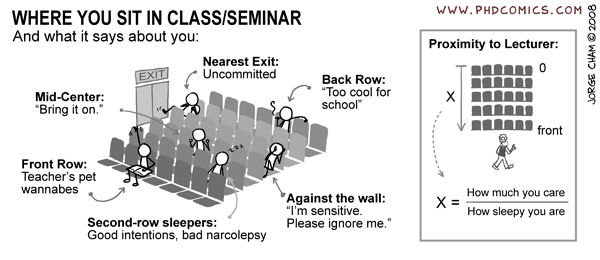
Where you sit in class and what it means


This is surprisingly accurate. Having taught for 13 years or so, and most of those in one room, I can predict with surprising accuracy where the distractive talkers will sit, based on hemisphere dominance, saccadic eye movement, and self-selected seating arrangement. I sometimes even make a joke at the start of the semester, walking over and saying, "I've never met you people in my life, but I know you will be cut-up, whisper-chitter slackers. Why do I know this? Because given how you look at things, and given where you're sitting, it's all been determined by the biology of your brain." Sometimes those students (or their acquaintances, not necessarily "friends") will ask did I hear something about them from somebody, because I was sure right about so-n-so. "No," I answer, "It's just that God was kind enough to build in an early warning system about them for the rest of us."

O.

REFERENCES

Labels: , , ,

Monday, February 25, 2008

My notebook + my brain = my mind?


{ Podcast this essay } If you were to ask someone to find the exact location of their mind, they would be unable to reliably do so. Obviously, there would be the common sense response that the mind is in the head; and, true enough, we are not completely lacking information about the brain. Still, the precise location of the mind is unknown, for there is not some special part the brain (the cerebellum, hypothalamus, or the like) wherein is held the location of "the mind." But of the many attributes which are often associated with the mind, relationships with physical components of the brain have been noted -- i.e., firing of neuron set X in some particular pattern has some correlation with varying beliefs, desires, or actions.

Since observation locates the mind as somehow in the brain (due to its relationship to the brain), it seems allowable that we could make similar claims regarding the mind’s location if it participated in similar relationships with (or within) other objects. There are some philosophers who have considered the possibility at length. In their article “The Extended Mind,” authors Andy Clark and David Chalmers take up this possibility seriously. They conclude that this relationship between the mind and various external objects is such that we should believe “the mind extends into the world."[1] In some ways this is obvious. The mind is in the brain, and the brain is in the world; therefore, the mind is in the world. Yet Clark and Chalmers have something a bit more radical to offer. Yes, we might agree that the mind is in the brain, but does the mind have to be completely and only in the brain? They think it does not, but the issue isn't so clear, as I'll try to suggest in a moment.

I. Otto and Inga

The authors argue their point in regards to the beliefs of two hypothetical people, Inga and Otto, who are described in the following way: Inga hears from a friend that there is an exhibition at the Museum of Modern Art. She thinks for a moment and recalls that the museum is on 53rd street, so she walks to 53rd street and goes to the museum. On the hand, there is Otto, who suffers from Alzheimer’s disease, which necessitates him carrying a notebook around with him everywhere. When he learns new information he writes it down. (Otherwise, he's likely to forget the information.) Like Inga, Otto also hears about the exhibition at the Museum of Modern Art. So he consults the notebook, which says that the museum is on 53rd Street, so he walks to 53rd street and goes into the museum.[1]

At this point a philosophical question arises -- Is Inga’s relationship to her beliefs sufficiently the same to Otto’s relationship to his notebook (an external object) to warrant calling both an extension their mind? The notebook fulfills an informative role for Otto that Inga’s beliefs fulfill for her, so the two cases are analogous in this respect. There are some other minor differences between the two cases but these are shown to be shallow differences that should not hinder one from drawing the conclusion that the notebook is, somehow, an extension of Otto's mind. Granted, Inga's beliefs are somehow coded in gooey material called brain matter, while Otto's beliefs are encoded in paper within a spiral notebook. But that doesn't make any relevant difference. Imagine a friend arguing that since you recorded your piano recital on a laptop's hard drive, but that since he recorded it on a .mp3 player; therefore, he has the real recital recorded, but you don't. You would rightly chide him by saying the media doesn't make a difference. Perhaps Otto mumbles such rebuttals under his breath about his friends and their so-called "real beliefs."

The similarities do tempt us to say Otto has (some of) his beliefs about an art museum in a notebook, and Inga has some of her beliefs about an art museum in a brain. Yet, there is one problem which might be considered a “deep difference.” This difference is in regards to the directness of the relationship between Otto and his notebook. Clark and Chalmers incorrectly believe that Otto’s notebook contains his beliefs but in reality Otto’s belief is about the notebook. To see this consider the following scenario: Suppose you were to sneak over to poor, unaware Otto, momentarily filch his notebook, and then write in it a completely untrue fact -- i.e., 2+2=5. Nothing changed with Otto at the moment we did this. It's uncontroversial that someone who believes 2+2=5 is irrational. If Otto’s notebook really does contain Otto’s beliefs, and among the list of his beliefs is '2+2=5', then we are forced, after the filching incident, to call him irrational. But Otto is not irrational because of a change we made to his notebook! Thus, it seems Otto’s beliefs are not contained in the notebook after all.

This difference between Otto and Inga hinges upon the very location of the notebook: its external relationship to the brain. Due to this relationship, the notebook is not linked in the right way into the rest of Otto's beliefs. Consider how this is different from Inga's beliefs and their linkage. If Inga’s belief were to be change from 2+2=4 to 2+2=5 she too would believe the latter equation. And we would thereby consider her irrational for holding such a belief.

II. What is, and where is, the Mind?

At this point in considering Otto's case, is one in a place to argue that the mind is not, or even cannot, be external to the brain? Such an argument is difficult to get started, because it requires a definition of ‘mind.’ But since there is no universally agreed upon definition, this means the debate could quickly deteriorate into a battle of deciding by definition -- i.e. by finding the answer in the way the question is asked. Instead, just outright grant that Clark and Chalmers are right: namely, that given the mind’s relationship to the brain and its relationship to external objects which encode beliefs, the mind is partly external. What does this entail about our concept of the mind? The mind now could become extremely extended; because, there is in principle no limit which need ever be given to extension (excepting the limit, of course, to the volume of available space in the physical universe.) Furthermore, almost any physical object can hold information (or, in this case, beliefs) for a person; and, therefore, would be an extension of one's mind. Yet we often equate the mind, to at least some degree, with being personal property, as it were; or with being unique to an autonomous, thinking self.

Consider the more mundane course in real life: when a student's notes from a class get lost in a windstorm, we do not say that the student lost part of his mind or accumulated beliefs from the class! Likewise, we should not say of Otto's notebook that were he to loose lots of scrawled notes in a windstorm, he has thereby lost lots of accumulated beliefs from his life.

Here is the best way to look at the Clark and Chalmers case for there being an extended mind. They have merely fancied up an uncontroversial position: The mind is involved in causal chains with external objects. Very few would deny this position. But they try to extend this point by claiming that this causal chain relationship between external objects and the mind entails an external component to the mind. They err in subtly slipping from talking about information channels into the mind with talking about the mind itself. Object x (a mind) being in object y’s (notebook) causal chain does not make x equivalent to y. For example, a bat hitting a baseball or a bat being hit by a baseball does not make a baseball and a bat the same kind of thing.

III. Conclusion

So here is the overall summary of the issue. Clark and Chalmers start with commonly accepted notions about the mind’s interaction with the physical, brain-external world. Their whole argument is set around the claim that there are not enough differences between Otto’s relationship to his notebook from Inga’s relationship to her brain to warrant the two cases being distinct. Though the cases have similarities, and though external objects can have causal effects on the mind, these philosophers take things too far in saying that the mind is external. The mind can be in causal relations with objects, but need not be accounted as wholly identical or even partially composed of those objects. This is often the problem with philosophers -- they just bewitch us with their thought experiments and subtle confusions about things which are already difficult enough on their own.[2]


REFERENCES

[image] from Terrami blogsite. (Accessed Feb 24, 2008)

[1] Andy Clark and David Chalmers “The Extended Mind” in Brie Gertler and Lawrence Shapiro Arguing About the Mind (Routledge, 2007) , 185.

[2] This essay is substantially indebted to ideas and analysis put forth by Chris Schafer.


O.

Labels: , , , , ,

Thursday, March 29, 2007

Q: Are our inner thoughts identical to our spoken words?


{Audio this essay @ 6min @ 1.34MB}

Dear Mr. Supposed Philosopher:

My supervising attorney ponders whether, "When we think, are we hearing our own thoughts in the same manner as our own spoken word?" In other words, do our thoughts sound to us like our own words do?

Signed,
My Boss Is Mind-gaming Me.


Dear Mr. Too Many Voices In Your Head:

1. There is a common view, since the time of the Enlightenment philosopher, Descartes, that our minds and our consciousness are transparent -- i.e., these words refer to the same thing. Since many of our thoughts are linguistically based, and since these are often the types of thoughts we present to ourselves for review, often reinforcing our short term memories; therefore, we naturally assume that our thoughts are linguistic entities, roughly phrases and sentences. Now our thoughts need not be spoken linguistic entities, since we can perfectly well review long memorized portions of texts w/o moving a single muscle in our face, and when we are sleeping we often are seen lying perfectly still, but upon being roused will report having a dream where we are "talking" or "speaking to" someone.

Again, suppose a bullet gives one brain damage to the left hemisphere, the locus of speech for right-handed people -- such a person, though now mute may still have the full ability to write-out sentences, though he can no longer form spoken sentences. Such cases alone would be enough to show that our own thoughts need not be the same as our spoken word. And, technically, we do not "hear" our own thoughts, since there are no sound waves moving into the ear and being processed by aural centers of the brain; thus, when we say we "hear" our own thoughts, this is metaphorical language for the stream of consciousness, some of which is linguistic. (I will say more about this technicality in a moment.)

Also, consider the (admittedly sad) cases where some children are never taught to speak, but yet they still recognize patterns in the world, such as who brings their food, what it means when the bell rings five-minutes before bed time at the orphanage, etc. These children cannot have linguistic entities as thoughts, since they have had no linguistic training at all. Perhaps they have streams of imagery that substitute for their inner experiences, where we (normally trained language users) have streams of linguistic phrases which substitute for our (otherwise inner) experiences.

So too, consider the simple case of sleep walkers, who can negotiate the location of furniture, and even drive cars and push (unstarted) lawn mowers around the yard at night. Here there is no internal or external utterance at all about what to do, and where to walk, how to plant, etc; and yet thought (i.e., active brain processing with command and control of actions) is certainly occurring.

Finally, perhaps the easiest case of all is noting how we hold our head level when walking, talking, sitting, etc. No one continually reminds themselves, "I've got to hold my head level", "Hey, gotta keep the ol' noggin from bobbin," "Steady, steady, there -- thank God! -- level again!" And it's not quite right to presume we do this “without thinking", because there is indeed active brain processing with command and control of actions, namely keeping one's head at the right position over various circumstances.

Thus, and for all these reasons, hearing our own thoughts is not THE SAME AS our own spoken word.

2. Now a different question would be whether the tone, pitch, timbre, etc. of our own thoughts match that of our spoken word. Here there could be a confusion, for as mentioned above, there are not sound waves being emitted by thought, hence technically thought cannot even have tone, pitch, timbre, etc. since these are all different ways of partitioning the analysis of a sound wave.

There might be analogical similarities that I note between the phenomenon of experience called "the inner voice" and the phenomenon of experience noted by "what I'm hearing with my ears when I talk", but it's merely an analogy, not the same thing. Compare a photograph that looks very much like one's brother and the brother himself; similar in many respects, but hardly the same thing. (For instance, one weighs 229lbs [fat]; the other weighs perhaps but a couple of ounces [thin].)

But even when we note the analogy between the (so dubbed) inner voice and the feedback of our own voice, we might not always experience the same inner voice. Imagine that one's wiener dog has urinated on the carpet during a thunder storm, and one begins to angrily move toward the dog in order to beat it severely with a size 12 workboot. One might suddenly recall a voice of a kindergarten teacher from decades ago saying, "One should always be kind to our pets." Here is a clear and present thought, directly tied to an immediate situation and within an on-going action, but one which is instantly recognized as a completely different type of inner voice as we are otherwise used to identifying as that "voice" of our own thoughts.

Thus, and for all these reasons, our thoughts need not, and often do not, sound to us like our own words do.

3. In summary, the following two statements are false: (1) hearing our own thoughts IS THE SAME AS our own spoken world. And (2)our thoughts always SOUND TO US AS our own words.

REFERENCES

[image] fiber/DIMENSIONS gallery

O.

Labels: , , , , ,