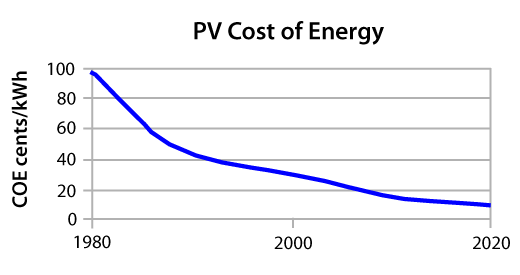
When GPS- enabled microprocessors are as pervasive as paper and just as cheap, what then?
What is 'property'? I got stuff; you got stuff. But which stuff is mine and which is not mine? At work I have two or three staplers. They have sat in my office, being punched now and then, for about 14 years. But I don't consider them mine; they are the school's property. I'm moving the pointer around on this MacBook by means of (ironically) a USB Microsoft mouse. I bought it just yesterday at Walmart, yet it's not Walmart's property -- it's my property. If one night I caught the school president, red-handed, sneaking out of my office carting away my staplers and school envelopes within a burlap bag, I'd call him a jerk. But if I caught him likewise carting off my books and coffee maker, I'd call the cops.
The above thought experiments get at some of our intuitions on the matter, but do not identify all the types of property. Typically, property is classified in three genera: land, items of a personal kind, and (the ever-nebulous category of)
intellectual property. Here we will be concerned only with personal property.
1. Property and 'rights'In biology, 'genera' is a taxonomic category consisting of a group of species exhibiting similar characteristics. So too, all the different genera of property seem to share something concerning
rights. Certain rights are accorded to the
owner of the property. Once explicitly stated, property rights are pretty much in accord with our common sense: (1) The owner gets to use or control the property. (2) The owner gets to buy or sell the property as s/he sees fit. (3) The owner gets to keep others from using it. And, most importantly, (4) the owner gets to collect benefits from the property.

Consider an example to bring out some of the implications of these property rights. Suppose I go to the store and buy a can of Campbell's mushroom soup. Along with some greasy German sausage and my propane BBQ grill, I pack-up my soup and head-out to a much over-grown campsite in a state park for a nite's stay. Now,
Douglas R. Conant, President and Chief Executive Officer of Campbell Soup Company, happens to be in the camp site next to me. He curiously watches as I pull out a couple of sturdy wool socks and double-cover the soup can. At this point, I begin to wildly swing the can-n-sock apparatus around, knocking flat all the overgrown switch grass and cat tails. I then remove the soup can, open it, and begin trying to shake the gelatinous, mushroom soup contents out, so as to use the can as a grease trap for my BBQ grill. (Fortunately a hungry, but well-financed, boy comes along with an empty styrofoam soda cup, and I sell him the contents for a handsome profit of five bucks.) Finally, I then peel off the label, and, with the help of a magnifying glass, use it to start the grill's fire. Mr. Conant has had enough. He runs over. "Excuse me," he says, "I happen to know a bit about Campbell's soup products, and these shenanigans of yours are definitely not what the company had in mind for that particular item." Admittedly, he lectures me with some authority on the matter.
How might I answer him in light of my property rights? Quite straightforwardly, I may say that, as the owner, I get to use the can of mushroom soup anyway I please. If I want to sell its contents at a profit, then so be it; or, I could have kept the soup for myself and dumped it on the ground. It's my decision as the legal owner. Furthermore, not only was part of its contents to my advantage financially, but the tin can is highly temperature resistant, so as to be adapted to my ends. Thus, again as the rightful owner, I may enjoy both benefits.
However, sometimes property rights are not as straightforward as the above example makes them appear. I happen to own a house in Oklahoma oil country. I bought the land, and some kind man took my money and built me a house upon it. Also, there is a well on the land, which means I can draw water from the ground. But I can't draw just
anything from the ground. Owning the property gives me the right to the water, but I don't have what's called 'mineral rights' -- which is "the ownership of minerals (coal, oil, gas, etc.) under a given surface and the legal right to enter that area and mine and remove them." Ownership of mineral rights also "includes the right to use as much of the land surface as may be reasonably necessary for the conduct of mining operations."[Calf] This means that
Mr. Golden Driller and his heinously dusty trucks could make dirt-scar roads into my backyard so as to access one of his many oil derricks. Admittedly, an eye sore, but too bad for me.
2. Property and 'ownership' 2.1. Just what is owned?
One way of seeing the situation is that maybe Mr. Driller and I are not co-owners of the
same piece of property; instead, we own
two separate properties, but as a practical matter they are (inconveniently) inter-twined. But another way of seeing the situation is that I own
one set of attributes of the property, while Mr. Driller owns
another set of attributes of the same property. Which is right? Imagine two minor deities proclaiming their respective areas of authority. One says, "I am the god of circles!" The other says, "I am the god of triangles!" A troublesome worshiper comes along and asks, "Uh, who's the god of cones?" In philosophy, arguments like this fall under a topic called
'material constitution'I predict that the continued (and eventually complete) penetration of microprocessors into the mundane objects of the world will exacerbate issues like those seen in the mineral rights case. Before showing this, there is related issue about property which must be addressed.
2.2. Tracking what is ownedLast week, Intel introduced the first products of a new generation of system-on-a-chip (SoC) designs that will target markets in
"consumer electronics, mobile Internet devices, and embedded systems. Currently, these new products each contain four chips -- a CPU core, memory controller, input/output controller, and acceleration technology -- integrated into one system. Intel claims the SoCs are 45% smaller and uses 34% less power than other Intel chips with similar capabilities."[InfoWeek]
One of the declared uses for SoCs is telephony and wireless infrastructure. The full version of SoCs will hit when there is mass production of Atom, which is "one of Intel's latest 45-nanometer-scale manufactured processors. The low-power chip available with one or two cores is expected to have a clock speed ranging from 800 MHz to 1.87 GHz and is aimed at ultramobile PCs, smartphones, mobile Internet devices, and other portable and low-power applications." Later, even graphics processing will be added to the die. In the longer run, Intel is banking on what many futurists have been predicting for years -- that there will be "an emerging market that will someday encompass billions of next-generation Internet-connected devices, ranging from handheld computers in people's pockets to home health-monitoring devices sending patient data to doctors in a medical center."[InfoWeek]

Actually, the idea of billions of devices understates things, since any given item that can be given a barcode could just as well be given a full system-on-a-chip, if the price of such systems were as cost effective as barcodes -- that is to say, if such systems were as cheap as paper. A single sheet of paper costs about one-half cent, and many minimum-sized barcodes can fit on a single sheet of paper; thus, the area of a sheet of paper divided by the minimum barcode size gives a pretty good approximation of the significant raw materials cost of affixing a barcode on a label. I am unclear how many barcodes are actually present on currently marketed products, but I do know that over 330 billion barcoded manufacturer paper
coupons are issued in the US annually.[Barcode]
And it is an accepted truism that computing hardware gets smaller at a known rate, and that processing power also advances at a
known rate. But the interaction between computers is now being seen as also of importance. 'Cloud computing', seen as a common pool, becomes more powerful when additional processors are added as resources. As whole systems become cheaper and more ubiquitous, the costs of storing and processing data become all the more cheaper. For now, wireless devices do not lend their unused cycles to The Cloud, but eventually this would seem to be in the interests of everyone. The reason this does not happen is probably based on risk assessment: there's a worry about privacy, spam, and firewall mischief. But such risk might not matter when there are so many devices with computing power that no single one stands out as worthy of cyber-attack. Books used to be chained to iron bars because they were so rare and valuable. Now, they are freely available to the public in libraries, and loaned out to the most shady commoners. Soon enough, wireless computing resources will find a similar nonchalant role in everyday life.

Eventually a can of mushroom soup can report its date to the refrigerator, which might be a grocery-monitoring clearing house for when things have spoiled, sat on the shelf unused for months (or years), and for how money is spent on what food consumption. Indeed, virtually every piece of property will be in wireless dialogue with many other pieces of property. The exact state and location of each duly and continually reported. All of this has been noted before by observers of technology.
Such a world of self-reporting property brings up many questions. So akin to the question of land rights and mineral rights is another: Are there wireless rights?
3. Wireless property rightsIn some ways, issues of privacy are really just another way of thinking about property. A person wants the ability to control what information s/he reveals about him or herself in the public space, whether it be print, media, or Internet. Ultimately, a person wants to control access to information, albeit of a personal variety in the case of privacy. Thus, information can be productively thought of as a kind of personal property.

Some kinds of property are shared in common. For example, clean air is a good which is desirable for everyone; it is shared, and offers benefits to the community. Sometimes, however, what is desirable for one set of people is not desirable for another set. Suppose after his camping trip, Mr. Conant realizes he's been quite shaken by my strange usage of his product, and decides to propose a most peculiar agenda item at the next meeting of the
Grocery Manufactures Association (GMA). The association will equip a fleet of trucks with wireless routers and surveyors, and drive through my neighborhood to see what other sort of GMA associated products I have sitting on my shelves. (Remember, this is the future where microprocessors in products are now as cheap and ubiquitous as bar codes.) It might be quite desirable and useful for the GMA to see what sorts of products are in my possession, and also for how long I've had them. But this is information I do not want them to have about me.
The GMA might argue that such information, like air, is free to all. Just as one steps out on a cold morning and breaths in an open lung-full of air; so too, they are merely taking advantage of the open spectrum of detection. After all, they might further argue, the
Brick Industry Association (BIA) recently drove through the neighborhood and took pictures of all the houses, and then ran these photos through an advanced color spectrum scanner. The BIA company then determined what the most popular preferences were for bricks. And no one charged them with invasion of privacy, since they kept on public streets and acquired information which was accessible from a public area. We are doing the same thing, the GMA concludes, but instead of using light spectrum, we are using radio frequency spectrum to determine popular grocery preferences.
Here the allusion to mineral rights becomes straightforward. Once again, owning the property gives me the right to use and store things as I will upon it (or within it), but perhaps I don't have 'information rights' -- which, perhaps, is the ownership of radio spectrum within a given area and the legal right to exclude that spectrum to common use.
Like mineral rights, ownership of information rights could perhaps be bought by others, or simply not excluded to others, so that they have the right to inventory spectrum-emitting devices in ways that are reasonably necessary for the conduct of information gathering for commercial reconnaissance. Thus, the GMA and their modified router campers could cruise up and down my street all day long so as to record the inventory reporting of my products.
Again, Mr. Conant, as a member of the GMA, and I, as a private purchaser, are not co-owners of the same piece of property -- say, a soup can; instead, we own two separate properties, but as a practical matter, they are (inconveniently for my privacy, at least) inter-twined. Or, maybe the soup can is a single item, but I own one set of attributes (i.e., its contents, container, and function for use), while GMA members, among others, could buy another set of attributes (i.e., its reporting information) of the same property.
4. ConclusionWhen GPS-enabled microprocessors are as pervasive as paper and just as cheap, I think a second round of discussion of property rights will be forced upon us. The questions unfold in ways parallel to the common sense notions of property outlined earlier: (1) Will the wireless information associated with the property of an owner be controlled or used solely by that owner? (2) Will the owner get to buy or sell that information as s/he sees fit? (3) Shall that owner get to keep others from using that information? And, finally, (4) Does the owner alone get to collect benefits from the information associated with property?
Just as the patent office wrestles with the subtleties of what abstract structures can and cannot be patented -- e.g., formulas cannot, software can; likewise, what counts as common goods, public goods, and private goods will also force society to delineate what kinds of abstractions can be controlled by individuals, corporation, and government.
REFERENCES[
image] CMEA Ventures
[infoWeek] Antone Gonsalves "
Intel Revamps Its System-On-Chip Design"
Information Week July 24, 2008 (Accessed July 24, 2008).
[calf] "Mineral Rights" Glossary
The California Forest Products Commission (Accessed July 24, 2008)
[Barcode] "
Coupons"
GS1 US Barcodes and eCom - The Global Language of Business (Accessed August 8, 2008)
O.
Labels: automotive technology, material constitution, microprocessors, Philosophy, Property, Rights