Sunday, April 16, 2023

Me and Duplicate Me


What makes for a meaningful preservation of my particular identity?

I was listening to Max Tegmark being interviewed about A.I. on the Lex Fridman podcast.  Tegmark suggested an interesting thought experiment as a quick aside to the conversation he was having within the first five minutes of the interview.  I'll dress it up a bit:

Suppose that a) people can back up their brains onto a computer; and b) a person, `Jake` discovers the plane he is on is about to crash, ending his life.  Furthermore, suppose Jake had backed-up his brain four hours ago.  

So then, consider this this question: How should Jake feel about his impending death?

If we assume that people can back up their brains onto a computer and that Jake had done so four hours ago, then it would mean that his current consciousness exists in two forms: the biological form that is about to perish in the plane crash, and the digital form that was created four hours ago.

From a purely rational perspective, Jake might feel less concerned about his impending death because he knows that his brain has been backed up and that his digital self will continue to exist even after his biological self has perished. All good!  

However, the emotional response to death is a complex one, and it might not be easy for Jake to simply ignore his impending doom. On the one hand, Jake might feel a sense of relief that his digital self will continue to exist, and he might even view his biological death as a form of sacrifice for the continuation of his consciousness. So, maybe what is value is that Jake's life projects will continue, and that people who love him would lose no more of what's valuable to them about Jake than as if he had taken, say, a four hour nap on plane instead of staying awake. 

On the other hand, Jake might feel a sense of loss for his biological self, and he might be worried about the pain and suffering that he will experience in the moments leading up to his death. But how much loss?  Suppose I think back to when I was a teenager.  That was many decades ago, and I've changed so much since that point that any "loss" I've felt from not being that person doesn't seem like much.  Indeed, there were things I now feel were misfunctions of character that I'm glad are no more So maybe the loss Jake feels would be trivial indeed, if one can reconcile the loss of one's teenage character so easily.

Ultimately, how Jake feels about his impending death will likely depend on a variety of factors, including his personal beliefs about death and the afterlife (if Jake is religious), his emotional state at the time of the crash, and his attachment to his biological self. 

Is is possible that people might have to ask this question for real in the future, given how technology proceeds? 

It's certainly possible that people may face similar questions in the future as technology continues to advance. As we develop more advanced brain-computer interfaces and artificial intelligence, it's not unreasonable to imagine that it may eventually become possible to back up our consciousness or transfer it to a digital form.

However, there are still many unknowns and ethical considerations to consider before such technology could become a reality. For example, we don't fully understand the nature of consciousness or how it arises from the complex interactions of our brains, so it's unclear how feasible it would be to create a digital copy of a person's consciousness. 

Additionally, even if we could create such a copy, there would be many ethical questions to consider, such as the status of the digital copy and its relationship to the original person. Imagine an extension where Jake goes down over an ocean, survives by washing up on a desert island, and gets rescued six months later, but his family has re-incarnated his backup.  Does the backup get killed-off so that Jake can sleep in his own bed again?   Is my backup persona my "property", since I preceded it both historically and causally? 

I have no answers here, and no strong intuitions on this either.  I do think there is a direct analogy to how we might think about backing up our A.I. creations, especially if they pass the Turing test for 99.99% of the population.  The future is really getting weird.


Labels: ,

Tuesday, April 08, 2014

Rethinking Abortion in Light of Advancing Technology


Advances in technology will eventually change how one prioritizes which ethical "rights" get invoked for or against having an abortion.

{ Audio .mp3 (7 min.)  of this essay } For my Ethics class I regularly re-read Mary Ann Warren's 1973 article, "On the Moral and Legal Status of Abortion."[1] Although it is well argued, I can't agree with every sub-conclusion she draws which would be required to justify her overall position -- hardly a surprise, of course, given my pious commitments.

In a postscript to the article, she attempts to show that her argument for the moral permissibility of abortion does not commit her to infanticide. Why not? Because after the infant is born, "it does mark the end of its mother's right to determine its fate." I have two points of disagreement with her on this matter of infanticide -- one minor, the other more substantial, but which is somewhat related to the minor issue.

First, I have never been clear on where alleged moral "rights" come from, at least if there is no all-knowing issuer and (eventually) absolute enforcer of those rights (otherwise known as God). In contrast, political rights are far more easy to understand and apply: Find the king, or the Constitution, or some other governmental authority, and then draw some sort of reference and subsequent enforcement from there. So my minor disagreement with Warren is that talk of moral rights only introduces further confusion into the abortion debate.

Second, even if one were to acknowledge some sort of discernible rights being affirmed or violated, I was curious about how the following aside from Warren would interplay with such rights:


"Indeed if abortion could be performed without killing the fetus, [the mother] would never possess the right to have the fetus destroyed, for the same reasons that she has no right to have an infant destroyed."

What might it mean to perform an abortion without destroying a fetus?

 
At first glance we might worry that just as murdering someone without killing them is impossible, so committing an abortion without destroying the fetus is likewise, for semantic reasons, impossible. But this is not quite a correct understanding of the term, because the very word "abortion" just means the deliberate termination of a human pregnancy, and does not, in addition, also mean the deliberate termination of a fetus's life. As we currently practice it, the act of abortion indeed causes the termination of a fetus's life, but that is merely an association due to our poor technology, not due to the prior logically entailing letter. Compare our use of the word "surgery" today as compared to times past. In the past, surgery always caused pain, but today we are fortunate to know that the association of these two terms is not one of logical entailment, as every anesthesiologist can attest.

With this semantic confusion behind us, we are now in a position to think about abortions, but without fetal termination. Perhaps we can imagine a specialized vat whereby we place a fetus within so as to grow it to viability. Advances in robotic surgery would allow doctors to remove the whole placenta quickly enough to
support the oxygen and nutrient environment which keeps the fetus viable, and then to reattach it to the artificial vat support system. In this case the woman would have terminated her pregnancy (accurately called an "abortion") but the fetus would still remain viable. Or again, perhaps the vat technology is too difficult a feat, but advances in biology allow a transplantation of just a small portion of the placenta, along with its accompanying fetus. Likewise, per as earlier, we would have terminated the pregnancy, but with the advantage of the fetus remaining viable.

In her postscript, Warren supplies two arguments on why infanticide is wrong (1) for reasons analogous to those which make it wrong to want to destroy natural resources or great works of art; or (2) for reasons whereby people value infants -- such as when foster parents who would want the infant would be deprived, or when greater society, valuing infants and willing to step up and support them, finance orphanages through the tax base. However, under advanced technology circumstances, these same issues would apply to the woman losing her "right" to commit an abortion, were the growth vat or the transplant biology advanced enough to remove the infant from the woman. Using Warrens own reasoning, just as the woman does not control the right to commit infanticide after the birth, neither would the woman control the right of feticide in utero.

Warren wants to say that the rights of actual people trump the rights of potential people, but I am unclear which rights are being mentioned. My suspicion is that there are conditions where the right of the woman's quality of life could very well be subordinate to the rights of a fetus to have life at all. Suppose that the surgery were no more troublesome than having a mole removed, or taking a few hours out of one's day for an anesthetic nap (for surgery), similar to colonoscopy procedure. Under these conditions there would be minimal quality of life degradation. Even if one acknowledges the presence of moral rights, there must be a hierarchy to these rights to make them workable, as both scholars and jurisprudence practitioners of legal rights have recognized.

Earlier in her article Warren wants to suggest that an actual person's rights (in this case the mother) always trump a potential person's rights (the fetus). I don't see why this should be accepted a priori. Indeed, the mother should not be presumed as the only actual person with rights in place. Instead, I suggest that it is the empirical circumstances and consequences which allow us to formulate the hierarchy of already-acknowledged rights. If one grants this suggestion, the consequences of the mother's degradation of quality of life could eventually be so low in the advanced technology cases mentioned that one should assess the fetus's right to life as super-ordinate over the mother's right to quality of life. If so, then I conclude that we shall soon be rethinking abortion in light of advancing fetal support technology.

O.

REFERENCES

Images: Header image taken from article, Soraya Chemaly "What Do Artificial Wombs Mean for Women?" 2/23/2012 RH Reality Check Blogsite (Accessed 4/8/2014).  Inset image taken from Green Diary - Green Living Blogsite. (Accessed 4/8/2014)

[1] Ann Warren "On the Moral and Legal Status of Abortion" [.pdf] The Monist: An International Quarterly Journal of General Philosophical (Peru, IL, 1973).


Labels: , , , , , ,

Tuesday, December 17, 2013

Uncle Philly on A.I.


Labels: , , ,

Saturday, November 30, 2013

Uncle Philly on Cyborgs


Labels: , , ,

Saturday, August 27, 2011

Human augmentation and other scary stories for Evangelicals


Twenty-one years ago a philosopher by the name of Stephen R.L. Clark wrote an article titled, "World Religions and World Orders". He essentially complains (indeed in several places simply rants without argument) that "there are good reasons for being suspicious of the very concept of 'a religion', let alone a 'world religion'. As is often the case with these kinds of arguments against using certain concepts, the author just happens to be -- surprise! -- a socially conservative Christian, and sports the strange mythological, apocalyptic views often associated with that crowd: "My fear is that we shall instead live to see the rise and fall of Babylon, that tradition tells us must precede the Coming."[1] By this he means Jesus: The Sequel, whereby God's messiah won't be so meek and loving the second time around. An ancillary thesis to his anathema over the possibility a unified concept of religion is the possibility of a unified culture for the religious traditions of humankind:
"So there are at least two futures for us that embody some ideal of unity: the rationally crafted Kantian vessel, and the baroque contrivance pieced together by a struggling crew. As far as our biological future goes, the latter has my vote. I had rather imagine humankind, lifekind, continue on the drunkard's walk through God's immensity than be re-engineered by certified experts."
If you detect any anti-intellectualistic undertones in the above quote, you'd be right; the article is filled with little asides depreciating reason, science, and anyone who would dare think that human beings might be able to manage their own future without relying on conservative interpretations of late iron-age values, originating from more sandier parts of the world.

Now something unique that caught my eye in the article was this notion of being 're-engineered' by certified experts', and Clark does expand on this later in the article. Again, as is standard shtick for Evangelicals, his tone is that we can't trust trust scientists any more than we can leash them with pietistic values, so it's best to warn the faithful when possible. In complaining about the works of Chardin, a 1930s intellectual, Clark notes,
"Scientific industrialism -- although its spokesmen regularly denounce old-fashioned dualisms of of 'matter' and 'spirit' -- actually embodies a powerful dualism of its own, between wild Nature and the technosphere. Sometimes its fantasies are of a space-travelling civilization that need never again adapt itself to a non-human environment (precisely by placing itself in that most alien and deadly space beyond the living Earth). Chardin's fantasies of the fantasies of the Overmind [...] are to be realized through computer networks, genetic engineering, bionic enhancement of sense and muscle. Those of us old-fashioned faith-holders who suspect that we shall not be allowed to 'build a tower to heaven', nor yet to remake our bodies and the living earth, can expect to be denounced as backward-looking obscurantists, to be swept away (as Chardin hoped) in the tide of progress"[1]
As earlier noted, this article appeared over two decades ago, but science has the benefit of accumulative knowledge and expansive technology, even with the intellectual drag of conservative clergy prophesying doom about human advancement. So while the idea that we can remake ourselves was just on the edge of loony in 1990, it's now pretty much an accepted fact about what is coming down the pike. Actually it understates the case that it is coming, for the first round of the technology is already here.

In a timely coincidence with my reading, a new documentary[2] has come out just this week which examines the human enhancement themes showcased in a well-received video game. (Video games are the vehicles of 21st century secular mythology.) It shows what is the current state of the most advanced prosthetics, and how real people are using these computer-enhanced devices. The filmmaker himself, Rob Spence, is known as "Eyeborg", because he has a prosthetic eye that can be activated by waving a magnet in front of it. The eye can record video, and in the documentary it uses some of the video from his eye as part of the narrative cinematography of the film.

Seeing this documentary re-emphasizes just how forward and insightful was the thinking of that 1930s writer, Chardin; but how backward and neanderthalic is Clark's understanding of religion and culture.  Sadly, Clark has lots of evangelical ditto-heads who think the same way.  But Chardin had an insightful analysis about them too.


O.


REFERENCES

[1] Stephen R. L. Clark, "World Religions and World Orders" Religious Studies 26 (1990), pp. 43-57
[2] Rob Spence "Deus Ex: The Eyeborg Documentary" YouTube 8/25/11

Labels: , , , , ,

Saturday, August 20, 2011

Google can soon peek under dresses with mapping robots.


And then everybody else could take the tour too


Google has a street trike which a person rides as the newest way to make maps.[1]  It allows the company to map even smaller and closer spaces than a full car could manage.  As a matter of efficiency, the principle is to shrink down the apparatus so more places can be mapped.  Clearly this principle is extensible until you have the smallest of robots scurrying around the nooks and crannies of every publicly accessible place. In principle, then, one could take the view of a mouse or a fly (eventually) and cruse around at Google's "street view" and see things from that perspective.  No doubt Google can already do this, but to explicity advertise such abilities would be too shocking for the public.  (But already used for intelligence agencies, of course.) Privacy concerns are already a touchy issue in Europe, and would be so here in the U.S. were it not for this country's general ignorance about the implications of its own Science.

O.

REFERENCES

[image] "Pesky fly or Peeing Tom" The Latest and Greatest Technology (Accessed 8/20/11)

[1] "Google Street View trikes up close" TechCrunch (Accessed 8/20/11)

Labels: , , , ,

Tuesday, February 15, 2011

Alex Trebek on Technology


"If you can't be without that piece of equipment, I think that's sad. We're becoming too attached to our technology. We need more time to ourselves, more time to sit and think and be quiet, instead of constantly being accessed. And as far as Twitter goes, are we so insecure that if we're not connected to somebody else every moment of the day, we're in a panic? What happened to the days of contemplation? The days of being self sufficient? Enjoying ourselves instead of being in contact with everybody else?"[1]

O.

REFERENCES

[1] From an excellent interview with him on Time Magazine's "Techland" site: Doug Aamoth "Techland Interview: Alex Trebek" Techland.Time.Com (Sept. 21, 2010)

[*] Another great interview with him on the recent (2/14/11) IBM-Watson vs. human champions on Jeopardy is here.

Labels: ,

Sunday, August 15, 2010

Nicely stated miniature, tech nerd.


In chess and in art, there are archetypal works called "miniatures."[1]  Other disciplines have them also, I'm sure; but, they don't often go under those names.  For example, here is a paragraph taken from an article in PC World, which I just happened across via Google's (highly useful, in my opinion) Fast Flip:
If you want to kill your child's Facebook account, and that child is determined to not let you kill his account, you pretty much have to go Full Amish on the kid for two solid weeks -- no computer access at home, school, library, or friends' homes; no cell phone access at all. Really, anything with a browser on it -- the Playstation, PS3, the Kindle -- is off limits. Try that with a 14 year old sometime and tell me how that works.[2]
That "go Full Amish on the kid" was a nice phrase, intimating a nice image, especially given the subject at hand.  I'm sure Weird Al would agree.

O.

REFERENCES

[image] Steynian Blog


[1] "miniature" Wiktionary (Accessed Aug 15,2010)

[2] "Facebook May Get a Real 'Delete Account' Option" PC World July 28, 2010 (Accessed Aug 15, 2010)

Labels: , , ,

Saturday, October 31, 2009

Mobile Phones as Leap-Tech for Developing Nations

It's hardly news that adding technology to a developing country's infra-structure boosts its economy, but stating an exact boost for a particular items is informative. From The Economist:
"An extra ten mobile phones per 100 people in a typical developing country boosts GDP growth by 0.8 percentage points, according to the World Bank, by helping small entrepreneurs flourish."[1]
The importance of the mobile phone as a communication device is well known, but as mobile computing and mobile phone technologies fully merge, I believe that the GDP growth by countries which leverage such "leap tech" will become even more amplified. Imagine if mobile phone users in such countries were instead issued iPhones. Even if such countries don't (yet) have the bandwidth to use all of the internet features efficiently, just the presence of a mobile computing device that allows its users to download very cheap applications would have broad impact on individual entrepreneurs, and hence on the economy overall.

Also, developing nations sometimes lack a reliable or fully expanded power-grid infrastructure. Power is often generated by fuel, which supply can be iffy due to such common contingencies as localized wars and weather disasters. But the low-power requirements of devices like mobile phones and mobile computers gets around this problem, since they can be recharged by fairly cheap, reasonably efficient solar charging devices.

Finally, it is possible to determine and analyze how people move around by examining mobile phone usage. Different social groups within a country interact in different ways. Traffic and disease patterns could also be easily tracked, since governments can note such usage and report on it much more efficiently, where before the presence of these devices such information would have been practically impossible to collect. Properly data-mined, the millions of mobile phones in developing nations can function as ad hoc sensors for national data-collection networks.

Mobile devices quickly come down in price and are easily introduced into developing nations. Thus, these nations will have a much shorter path to development than would have been otherwise expected just a few years ago.


REFERENCES

[1] "Fish Out of Water" The Economist Oct. 29, 2009

[*] The trend is their friend, and ours, since commerce most benefits when everyone can participate:


O.

Labels: , , ,

Sunday, September 20, 2009

Self-checkout lines: the future of education?


As do many millions of people in the U.S., I am now regularly forced to use the self-checkout apparati at such national chain stores as Home Depot (shown above) and Walmart (shown here, in case you live under a rock.) I must admit, I don't like them; but, I also admit they make personnel and commercial sense for the companies that use them. Afterall, a manager doesn't have to hire or fire a machine, and machines don't need insurance, or moral talk, or discipline, or that host of a zillion other interactions required for human resource management. My guess is that they also breakdown at a much more (quantifiably) predictable rate, and probably are easier to price and plan for installation than are employees.

In the 80s, I was a part of a (educationally profitable) band. One day, a few bandmembers and myself were standing around, killing time, and the drummer made a good-natured joke at one of the instrumentalist's expense. The bemused object of the joke retorted, "Hey, buddy, you can be replaced by a machine!" Back then it was quite funny, as the drum machines of the day sounded like a cross between tin foil being crinkled and wine-glasses being dropped. However, with today's technology any such retort would be quite accurate, and maybe also in bad taste. Still, even back then, a short conversation broke out on the matter about machines and drummers, with the eventual conclusion being that "you can 'hang out' with a drummer, but you can't with a machine." That was true at the time and is probably still true for a couple of more decades, though the general drift of how we'll first have A.I. buddies is now clear.

So, as has been well attested since the industrial revolution, people are being replaced by machines. Well, not completely, of course. At checkout kiosks, there is one employee who keeps watch over a half a dozen or so of the devices. The same thing happened in the yarn industry in the late 1700s, where one (lucky) employee could watch over eight or more Spinning Jenny machines. The difference, I suppose, is that now such replacements are occurring in the service industry, not just in the manufacturing industry. It used to be said that this wasn't so bad, since somebody had to be trained to fix the machines. An optimistic view, but not true to the employment threat, since the number of people displaced is far more than the number of technicians required to maintain the displacing technology, as is seen by the automobile industry's usage of robots (video).

The sudden rise of the internet was not at first a problem for the education industry, per se, but the super-addition of broadband tools which make the posting of audio and video almost effortless is. Add to this the ever more-powerful, free and open-source cloud-based software, and one begins to think that education would not require institutions like colleges and universities to deliver an adequate degree. However, at this point, it is way too early to make such a claim, since having access to information and learning a subject are two different things, as anyone who has bought a calculus or foreign language textbook knows.

From my observation, most of the educational success that occurs in formal institutional settings comes from peer motivation and personal coaching. People do best when operating in face-to-face social groups, whether in academics, sports, or even in casual exercise programs. World of Warcraft crack-heads not withstanding, the internet is not yet able to offer a significant substitute for this social activity. Granted, that it might offer this someday cannot be ruled out, but we do not have full immersive, three-dimensional displays (i.e., interfaces) nor even the internet infrastructure to deliver this. Furthermore, not all disciplines are skill-based, template-based, or procedural-based; or, put differently, education and Engineering are not the same kind of endeavor. Still, in the early stages of education, there is information that must be mastered, and often it is somewhat template-based--such as using a technical vocabulary, a fairly-standardized history of the discipline, and other lower-division kinds of overviews and introductions. And it is with these where educational institutions are being forced to change. By analogy, just because the checkout kiosk is tolerable for some retail activities does not mean I would want it for all of them. For instance, the case-by-case, situational complexities of medicine and chemistry means that pharmacists are still required to review and perhaps even discuss what products I get at the back of Walmart, even if the fruit and vegetable guy at the front of Walmart need not review me about my choice of onion.

Ultimately, universities will have to separate (1) content that can be delivered for impersonal learning from (2) discipline-specific knowledge that requires a certain amount of personal interviewing and coaching. Quite a bit of money has traditionally be generated by using instructors to teach the former, but it turns out the latter is the more difficult and important task of education. Acquiring data is one thing, analyzing it is quite another, as Astronomers, for example, well know. The internet will continue to be a fine (if financially disruptive) tool for content delivery, but as a student gets more content, there are subsequently more difficult issues in knowing what to do with such content, and that requires a mind-to-mind engagement.

O.

Labels: , ,

Saturday, May 16, 2009

Coal Plants and U.S. Electricity


You may wish they'd go away, but it won't be anytime soon.

There are a lot of worries about coal-fired power plants, since they pollute the air and are a significant cause of greenhouse-gas emissions. However, I did not realize just how powerful these plants are. In fact, The Energy Information Administration "reports that more than 600 coal-fired plants still produce about half of America’s power and will still produce 47% of it in 2030."[1] A full HALF of our energy is produced from but 600 or so coal plants! So they are not going anywhere soon.

It turns out that nine coal plants were canceled this year alone in the U.S. These plants "would have provided about 6,650mw of power, or enough to heat almost 5 mil. homes."[1] It appears that coal-plant technology is very efficient, and I can see the attraction of energy planners wanting to use them.

A typical coal power plant yields 500 megawatts, and produces 3.5 billion kilowatts over the course of a year, taking 1.43 million tons of coal to maintain this amount of electricity. It's difficult to imagine what these quantities mean, but here's something easier to wrap your mind around: 1 light bulb.

If you left your 100 watt front-porch light on 24 hrs a day, all year long, then you'd need to burn 714 pounds of coal to provide its energy. And, or course, there's the side effects of 5 lbs. of Sulfur Dioxide, and 5.1 lbs. of Nitrogen Oxide, both of which are the main causes of smog and acid rain. Also Carbon Dioxide is a cause of global warming, and your bulb would place 1,852 lbs. of that into the air as well.[2] Even if you just turned it on, or had it on an automatic timer for an eight-hour night that's still 238 pounds of coal over the year. Electricity is renewable, but the light bulb scenario shows that the by-products of electricity by means of coal usage are not something one wants to renew.

Many people worry about what I believe is the best solution to the energy crisis, nuclear power, thinking that it is somewhat more dangerous to the environment, but such is not the case: "a coal-burning power plant emits more radiation than a (properly functioning) nuclear power plant."[2] This is because a coal plant produces small amounts "of just about every other chemical element on the periodic table."[2] Therefore, the cumulative effect of those radioactive elements is one more problem for coal plants and one more advantage for nuclear plants.


click map to expand

O.

REFERENCES

[image] "Utah Coal Plant" All American Patriots Website (Accessed 5/16/09)

[image] "Map of Coal-fired Power Plants in the United States" Power Magazine Oct. 15, 2008(Accessed 5/16/09)

[1] "Coal-fired power plants: the writing on the wall" The Economist (May 7, 2009)

[2] "How much coal is required to run a 100-watt light bulb 24 hours a day for a year?" HowStuffWorks (Accessed 5/9/09)

Labels: , , ,

Monday, September 08, 2008

Petabyte management


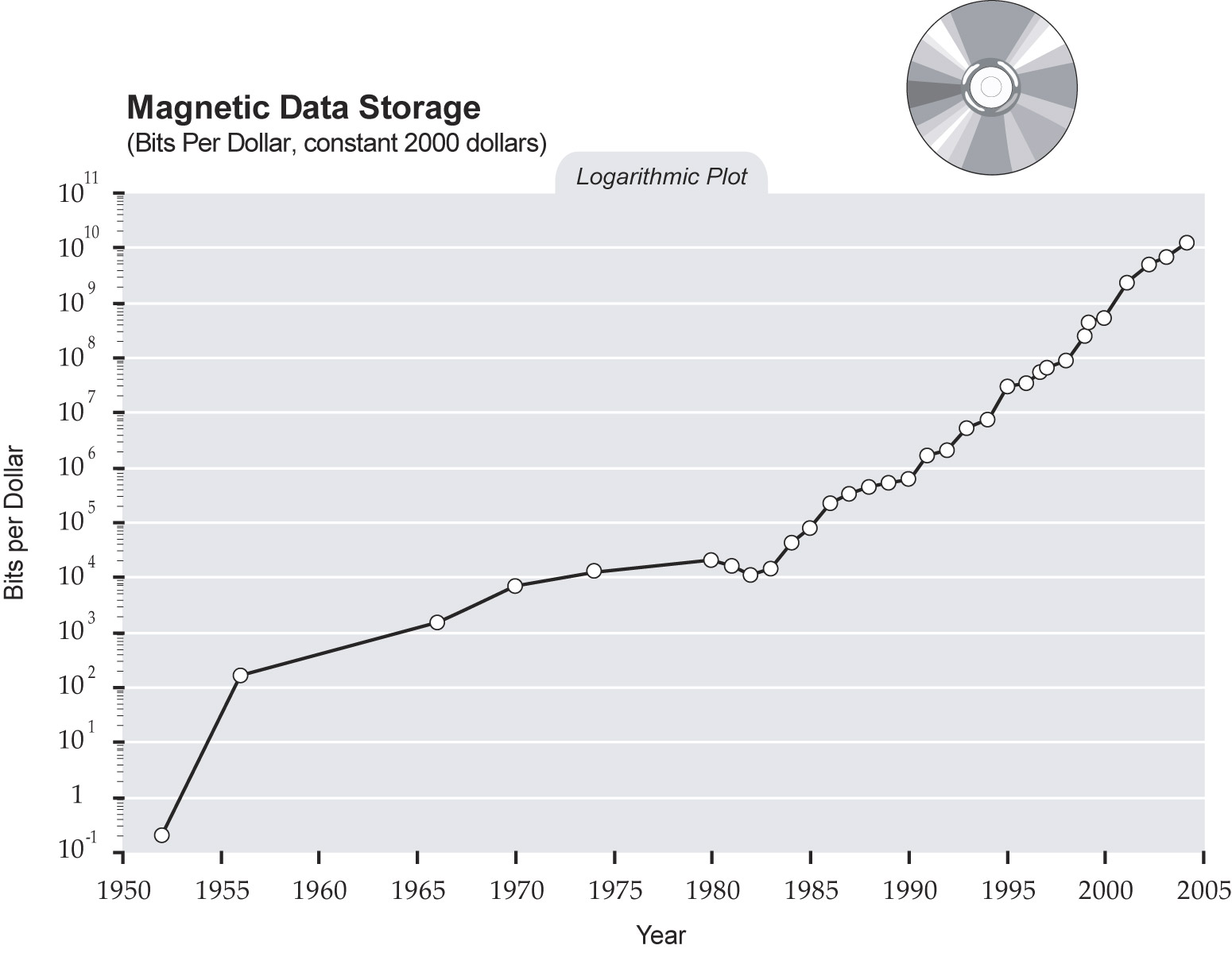
A gigabyte means nothing today, and storage technology is now being thought of in terms of terabyte units. Recent advances in harddrive technology have made such adjustments in thinking possible. But I recently ran across a quote which gives some indication of just how big a management problem Petabyte database storage would present. (A petabye is 10 to 15th bytes, equaling a quadrillion bytes.) Apparently, the advance of scientific instruments for measuring and collecting data far outstrip our ability to store such data. Alex Szalay, writing a commentary for Science News, gives a good sketch of the problem:
"Today, you can scan one gigabyte of data or download it with a good computer system in a minute. But with current technologies, storing a petabyte would require about 1,500 hard disks, each holding 750 gigabytes. That means it would take almost three years to copy a petabyte database -- and cost about $1 million"[1]
Of course if you have a moderate system, with standard U.S. broadband, you could actually send a petabyte to Hong Kong by sailboat faster than you could move it over the internet. Jonathan Schwartz makes just this kind of claim, giving his explanation in the following:
"So if you had a half megabit per second internet connection, which is relatively high in the US (relatively low compared to residential bandwidth available in, say, Korea), it'd take you 16 billion seconds, or 266 million minutes, or 507 years to transmit the data. Can you sail to Hong Kong faster than that? At a full megabit, just divide the time in half. Even at a hundred megabits (about the highest, generally available, of any carrier I've seen), it's a few years. [....] So yes, at least for now, it's faster to send a petabyte of data via a sailboat than the internet (at least defined by the bandwidth to which most of us have access)."[2]
There's probably good reason to think that sending a petabyte of data is a temporary problem, as increases in the technology of storage capacity and bandwidth move along at quite a clip. So transmitting a petabyte of data probably won't be much of an issue. However, as sensor technology will also be advancing, so we're probably in the permanent position of always being able to collect more data than we can comfortably transmit and store. This is probably some sort of corollary to a personal computer purchasing rule I read about some years ago, but which is still true today: The computer you want is always $5,000 more than you can afford.

REFERENCES

[image] "Magnetic Data Storage: Bits per dollar in constant yr. 2000 dollars" Singularity.com (Accessed Sept. 8, 2008)

[1]Alex Szalay, "Preserving digital data for the future of eScience" Science News August 30, 2008.

[2] Jonathan Schwartz "Moving A Petabyte of Data" Jonathan's Blog Mar 12, 2007 (Accessed Sept. 8, 2008)

O.

Labels: , , , ,

Monday, June 09, 2008

Go with Kindle or stick with Guttenberg?


In my profession, one must read a lot of books. And one must not only read them; you pretty much must like the whole process -- that of acquiring them, reading them, recommending them to others, and even displaying them like trophies after a great hunt. Yes, there have been many people who wax eloquently about books; so, it is with some difficulty that I'll resist the temptation to do so myself.

I suppose I should count myself an exception to the otherwise standard American adult: "A 2004 National Endowment for the Arts study reported that only 57 percent of adults read a book—any book—in a year. That was down from 61 percent a decade ago."[1] I was alive and reading a decade ago, and I assure you I read more now. (I have more time now.)

One implication of reading a lot of books is that one must maintain quite a bit of real-estate for a those books. I have an academic office with quite a bit of bookshelf space, but it's always pressed for space, and I am forced to hire a trustful, even persnickety undergraduate about every three to four years to rearrange everything back into a useable library. Sadly, in my study at home, family and friends are at risk of an avalanche, since I dutifly place books not only onto my floor, but into two, floor-to-ceiling shelves. But then, running out of space, I double stack them front and back on each self; and, finally, I start tucking them on onto the lip of the bottom shelf stacking horizontally, and eventually just sticking them whereever all mishmash. I've done this for two years. People are starting to remark that they fear looking at some book of interest, because to remove it is equivalent to risking an injurous jenga-like avalanch of books. (Anyone else want to fess-up to a similar problem?)

My continual acquisition of books also contributes to the overall badness of global warming and energy consumption:
Microsoft's Bill Hill has a riff where he runs through the energy-wasting, resource-draining process of how we make books now. We chop down trees, transport them to plants, mash them into pulp, move the pulp to another factory to press into sheets, ship the sheets to a plant to put dirty marks on them, then cut the sheets and bind them and ship the thing around the world. "Do you really believe that we'll be doing that in 50 years?" he asks. The answer is probably not, and that's why the Kindle matters.

And there it is -- the issue: The Kindle. What the heck is a Kindle? Well, here's the full synopsis, duly stolen from Wikipedia:
Amazon Kindle is an electronic book (e-book) device launched in the United States by Amazon.com in November 2007. It uses an electronic paper display, reads the proprietary Kindle (AZW) format, and downloads content over Amazon Whispernet, which uses the Sprint EVDO network. The Kindle can be used stand alone without a computer. Whispernet is accessible through Kindle without any fee.[1] On the release day, the Kindle Store had more than 88,000 digital titles available for download. Amazon's first offering of the Kindle sold out in five and a half hours and the device remained out of stock until late April 2008.[...] The Kindle features a 6" diagonal, 4-level grayscale electrophoretic display (E Ink material) with a resolution of 600×800 pixels (167 ppi), although the largest graphic image that can be displayed without being resized in a publication is 450x550 pixels. It measures 5.3 inches × 7.5 inches × 0.7 inches and weighs 10.3 ounces. The Kindle has 256 MB of internal storage, of which 180 MB is available on a new device. An SD memory card expansion slot is present, officially supporting cards up to 4 GB in size. It has 64 MB of RAM. The battery lasts roughly two days with wireless on, and one week with wireless off. The battery charges in about two hours. A USB 2.0 port (mini-B connector) is available for connecting to a computer (where it acts as a USB flash drive). [And] the Kindle features a headphone jack...."[2]

As Wikipedia articles on gadgets will, the description goes on and on. It recognizes all the text formats you ever heard of and, while a bit plain jane in looks, apparently works quite well.

Actually, I now know it works quite well. As I was writting this post, a collegue of mine called me into his office to see his new toy. Yep, it was a Kindle. My expectations of the Kindle and my experience of it matched. It is a nice device, feels just like you'd expect, and the on-screen text is superbly easy to read. It so happens my collegue is going for an overseas jaunt, and could not very well carry 20 books with him -- "It would be like packing another suitcase for the plane, and an overweight one at that!" 'Gotta give him that practical observation.

I might end up getting one of these, but at $350+, the cost is just a bit higher than I can see justification for at this time. I think the Kindle is the future of reading, though I wonder how long it will take all of these little carry-along devices -- phones, PDAs, bookreaders, laptops, etc. -- to integrate into a single universal information device. It's obvious that's where things are heading, but what's not so obvious is how a thrifty person is to make the transition in the mean time.

O.

REFERENCES

[1] Steven Levy, "The Future of Reading" Newsweek Nov 26, 2007 (Accessed June 2, 2008)

[2] "Amazon Kindle" Wikipedia (Accessed June 2, 2008)

Labels: , ,

Monday, January 14, 2008

Transhumanism and the so-called "future good" of humanity.

{ Podcast this essay } I hear lots of college age people (generally earlier in their college careers) claim that moral values are relative, and that people in different cultures have the varying moral values they do because they were raised in different ways. This can be treated as a hypothesis, and if correct, we would not expect to find a core of moral values shared across cultures. However, and contra to naive opinion, we do, in fact, find a core of moral values shared across cultures. Thus, people in different cultures do not have significantly varying moral values because of being raised in different ways.

Donald E. Brown is an anthropologist and has identified many emotions and moral concepts which are universally noted among humans:

"a distinction between right and wrong; empathy; fairness; admiration of generosity; rights and obligations; proscription of murder, rape and other forms of violence; redress of wrongs; sanctions for wrongs against the community; shame; and taboos."[1]

Other anthropologists have cataloged similar universals. I think such studies are indeed enough to show that human morality isn't relative, but I don't think its enough to show that the values themselves are not relative. If human values are formed by the successful reproduction and survival calculi of evolution-- that people have the values they do because such values contributed to their success as biological beings -- then its possible that in the future a different set of core, shared values could arise.

It might be that, as humans move out into space and radically modify their form by bio-engeenering and technology, those next generation humans will have likewise next generation shared values. I'm not sure what those values would be, and perhaps the state of my brain, formed by the biological past that it has, actually cannot imagine those values. If it is true that current humans cannot image the values systems of what future humans or human-originated creatures might be, this would be bad news for transhumanists (sometimes called "post-humanists"). Transhumanists seem to say that rational modification and enhancement of human capabilities is a good project. But good in what sense? It seems odd to say that what we perceive as good now, would indeed be good later. At least this is what Transhumanists seem to be committed to when they say such modification is a good project.

Consider an investment analogy: Putting money into some stock now is good, since it has been going up recently. (Where 'good' is defined as 'profitable'.) But that does not mean putting money into the stock now will be good -- i.e. profitable -- later. Circumstances of a company and of the company's environment can change radically. Typically, one would counter, "When the company no longer is good, do not keep putting money in it." But here is where the analogy can point out the problem with transhumanism: In the stock case, there is but one investor making the decision, but suppose there were several in a historical line, a string of investors, stretching into the future, but each with a slightly different investment strategy. Mr. A is a bit like Mr. B in his strategy, and B a bit like C, and C to D, and etc. on to the far future of Mr. R. But each strategy is only a family resemblance to the precursors. In fact, given enough tiny changes over time, Mr. R. could actually have a contradictory strategy to Mr. A, the initial investor!

To apply the analogy, then, the values of the present core of humanity (situation A) could be radically different, even completely contradictory, to future humanity (situation R). Therefore, it seems quite naive to agree with Transhumanists that rational modification and enhancement of human capabilities is a 'good' project for humanity's future. There might be other bases to advocate for modification and enhancement of human capabilities, but some future 'good' to the next human (or human-like) situation likely isn't one of them.


REFERENCES

[image] "Terminator: Sara Conner Chronicles" Fox.com (Accessed 1/14/2008)

[1] Stephen Pinker "The Moral Instinct" New York Times Jan. 13, 2008 (Accessed 1/14/2008)


O.

Labels: , , ,

Sunday, November 11, 2007

Intel chip manufacturing trends


Once again, Intel Corp. is ready to release a new line of microchips, and everyone is rightly bamboozled by them. This chart was taken from The Wall Street Journal (Nov 7, 2007), and is interesting for the trend it shows. It would appear that in very late 2008 or early 2009, on this curve, we should see a 30 nanometer chip with just over a billion transistors on it. The key to this is switching the underlying materials used in the manufacturing process. Silicon dioxide as been used since the 1960s, but now a material called hafnium will be used, since it is much more stable as regards temperature fluctuations which occur as such small scales.


O.

Labels: , , ,

Saturday, May 12, 2007

Transhumanism, Clothes, and Fashion Monstrosities


{ Podcast @ 3min } I have several axioms about technology. But one of them is: "Clever people will purposely do weird things with new technology." But the weirdness of it all becomes a bit too apparent when one casually peruses the troubled minds of artists during their wandering moments, even days of boredom.

Transhumanists study the possibilities and consequences of developing and using human enhancement techniques and other emerging technologies for the purposes of enhancing human mental and physical abilities. But what counts as "enhancement" and what counts as a mere stylistic experiment in self-expression will never be sorted out on objective grounds. Humans, it turns out, are not objective creatures at all, as is well attested by the life of the greatest logician of all, Kurt Godel; or by the more mundane examples of people who acquire enhancement of self-expression via tattoos.[1]

Technology will eventually follow the basic movements of clothing fashion, and since people wear clothing for both functional and social reasons, one can see the immediate allure of tossing a bit of technology into the mix. The main issue is how easy it is to acquire and remove the technology at hand. If having radical amputations so as to attach robotic arms were no more difficult than obtaining an ear piercing, and likewise no more trouble to re-correct, then the mere whims of pop culture will produce all the fashion monstrosities that we see in the world of cloth.

Amputation and robo-grafting will come quickly, but not with the shock value that it has today when we encounter such in art. This is because the natural trends of communication technology and convenient computational clothing will make the leap to transhumanist fashion just one more avaunt guard generational marker for the young. But what seems extreme in clothing now is merely passe tomorrow:
In the last few decades, there has been a consistent trend towards the mainstreaming of formerly extreme fashion, in which "over-the-top" becomes ordinary and loses any shock value it might once have had.[2]
Moreover, the engine of differentiation will require participants to wander further and further from the human form, even if not the human essence. Wandering from the human essence has been the main worry about transhumanism, but already there exists strange outward signs in popular culture.

It has sometimes been claimed that "clothes make the man." But soon enough, a new proverb will be necessary: "Fashion fashions the transman."


REFERENCES

[image] Brian Walker

[1] "Tattoo Blog" http://www.tattooblog.org/ (12 May 2007)

[2] "Clothing." Wikipedia, the free encyclopedia. (12 May 2007. )


O.

Labels: , , ,

Sunday, March 18, 2007

The Next Computer Interface Revolution


I was happy to see that the convergence of touch screens and big-screen TVs is progressing nicely. NYU professor, Jeff Han, has been busily advancing his research and has shown what the next computer interface will be. Take a quick 3 minute view of <the video>.

One can talk about holographic helmets, such as the air force and army use, but these seem far off as viable commercial devices, but the hardware technology for what is seen in the above video is already on the market. What Professor Jeff Han has essentially done is give us an interface mash-up, subsequently heralding the end of the mouse-driven interface.

I think this will carry the transition period between the mouse-driven computer environment (where we are), and the speech driven environment (where we want to be), though touch will never go away as an interface option, since one can do ten things at once with fingers, but only speak one word at a time with that flapping hole in the front of one's head.

Eventually, I would guess that the technology of projected keyboards [1] [2] will be expanded too. Perhaps one will step into (or lay triangulating devices around) a hot zone and then move the hands around in the air (as opposed to moving the hands around on the surface of the screen as Han is doing here in this video at a TED talk seminar).

O.

Labels: , , , ,